Partisanship stays high in the NH House, goes down in the Senate

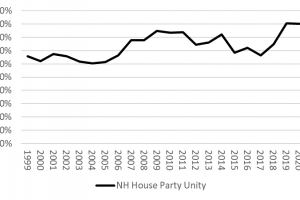
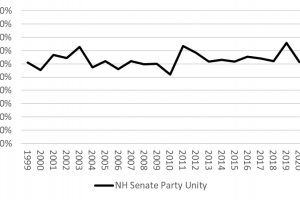
Last year Citizens Count found that partisanship reached a twenty-year high in the New Hampshire House and Senate (based on one measure). After updating those numbers for 2020, it looks like partisanship is still peaking in the House, but there was a big drop in partisanship in the Senate.
Measuring partisanship in 2020
There are many different ways to measure partisanship and political polarization, but arguably the most well-known is the “party unity” measure from Congressional Quarterly. Party unity is the percentage of votes in each legislative session in which a majority of one party opposed a majority of the other party. This reflects how often legislators drew a sharp line in the sand based on party, with few legislators crossing party lines.
Party unity was 90% in the New Hampshire House in 2020 – the same percentage as in 2019. Looking back over 20 years, that’s an all-time high.
It was a different story in the New Hampshire Senate. Party unity dropped significantly in that chamber, from 76% in 2019 to 62% in 2020.
Did the coronavirus have an impact on partisanship?
2020 was hardly a typical year for the Legislature, so we also looked at how the coronavirus may have impacted party unity.
The Legislature suspended activity in March, leaving hundreds of bills in limbo. When the Legislature reconvened in June, House Democrats and Republicans failed to reach a compromise to move legislation forward.
The Senate, in contrast, combined dozens of bills into so-called “omnibus” bills. At the end of a marathon voting day in June, legislators gave Senate President Donna Soucy a round of applause.
When you read that narrative, it seems like the coronavirus worked to divide the House and unite the Senate. However, the numbers don’t back that up. House party unity was 90% before and after the legislative shutdown. Senate party unity was at 60% before the Legislature suspended activity in March; in June, Senate party unity increased slightly to 63%.
It appears the partisan tone was set early in 2020, before the coronavirus emergency. That being said, hundreds of bills never got a roll call vote this year, and votes on those bills could have made a difference in the party unity score.
Are you concerned about partisanship?
Partisanship is not necessarily bad; it gives voters a clear choice and may even increase voter turnout. However, if you are suspicious of partisanship, you can elect representatives committed to bipartisanship and reach out to current officials to share your opinion.
At Citizens Count we also calculate party unity for each legislator, which shows how often they voted with their party against the majority on the other side. Click on “Elected Officials” on our website and select your town to find your state representatives and senators. We also track attendance and bill sponsorship.
If you want to learn more about party unity in New Hampshire, click here to read our original analysis.














Comments
Login or register to post comments